

Localization is one of those functions that everyone agrees matters right up until it’s time to fund it. Then suddenly it’s a line item to squeeze, a checkbox to tick, a problem to throw AI at and hope for the best.
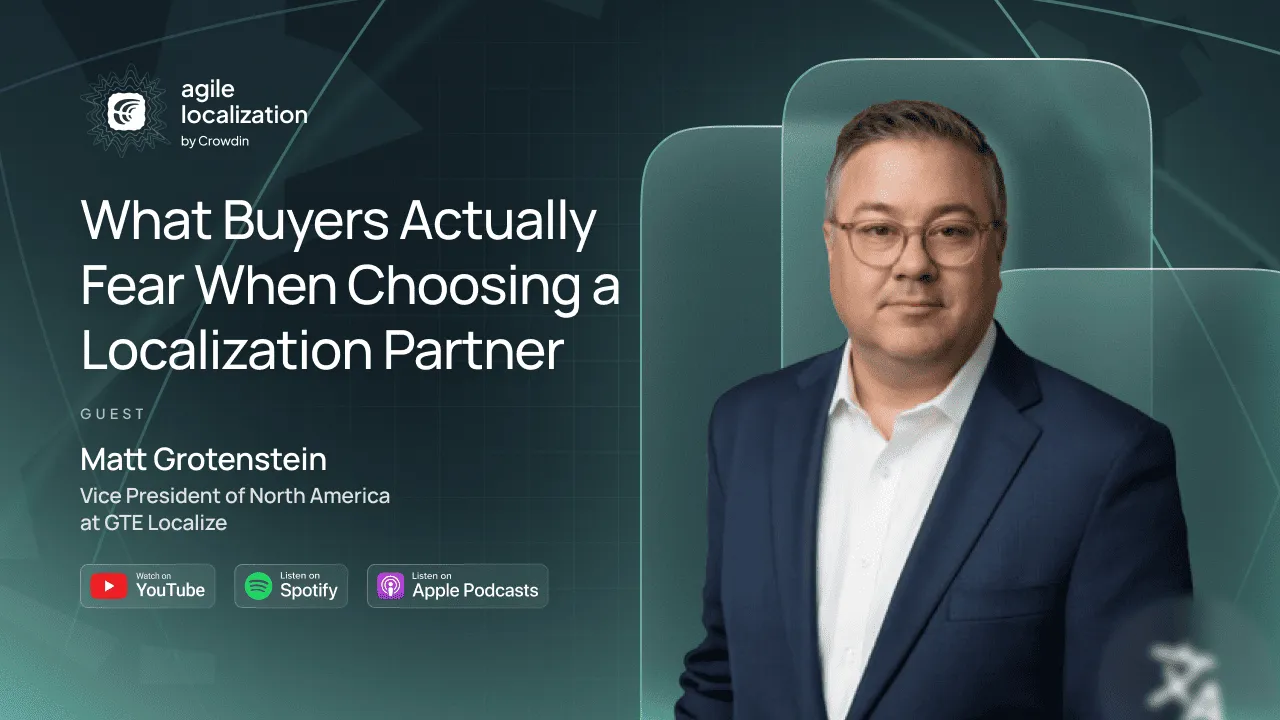
In a recent episode of The Agile Localization Podcast, host Stefan Huyghe sat down with Matt Grotenstein, Vice President of North America at GTE Localize and host of the LocReset podcast, to discuss why the gap between localization strategy and execution remains so wide and why AI isn’t the magic fix executives want it to be.
Listen to the new episode on:


What actually triggers the “We need localization” moment
Enterprise companies typically approach localization as a deliberate growth play. They have hit a Series C, they are scaling hard, and entering new markets is part of the revenue strategy.
Mid-market companies usually show up because they just closed a deal. Someone sold a software license into Germany, and now part of the statement of work requires translating the platform into the buyer’s language.
One is a proactive strategy. The other is reactive scrambling. Both need localization, but they arrive at the table with completely different levels of readiness.
The fear of losing the A-team
What are buyers actually afraid of when evaluating localization partners? It’s not really about pricing or technology. It’s the consistency.
Experienced localization managers have seen the pattern too many times: the vendor rolls out its best people during the sales process and the first few months, then quietly rotates in the second string. Quality dips, pricing creeps up, and faces change. That bait-and-switch erodes trust fast, and it’s the kind of thing that makes buyers skeptical before an engagement even begins.
Vendors miss the mark by listening to one voice
Where do vendors get it wrong? They latch onto a single champion inside the buyer’s organization and treat that person’s perspective as gospel.
However, localization decisions rarely live with one person. There’s a decision-maker, an economic buyer, end users, and often a technical stakeholder. If you’re not building a coalition and speaking to all of them, any one of those people can throw up a red flag and kill the deal.
It’s a sales lesson, sure. But it’s also an operational one. Programs built on incomplete stakeholder input tend to break down the same way.
AI is not plug-and-play
AI is not a solution in itself. It’s a means of becoming more efficient within a larger process. Too many companies treat it like a switch they can flip to instantly enter global markets, and that mindset leads to failed initiatives with no measurable impact.
Matt pointed to multimedia as an area where AI is delivering real, defensible ROI. But even there, it requires human oversight across three critical buckets: fixing structural issues the AI introduces, correcting linguistic errors, and feeding those corrections back into the system as training data.
What’s especially interesting is what Matt said about quality measurement. Despite all the excitement around AI-driven translation, he noted there’s still no widely accepted framework for evaluating AI output quality. The industry needs something equivalent to the old TAUS or LISA models. Without it, companies are flying blind.
The rising cost of AI tokens
Matt flagged the rising cost of AI tokens as a looming issue that not enough people are talking about.
The early promise of AI translation was that it would be dirt cheap. But as major AI platforms need to start turning a profit, token prices are climbing. The ROI advantage that made AI translation so appealing is starting to erode.
And the models that remain affordable tend to be the least capable. It’s a squeeze from both sides, and it’s going to force companies to rethink the economics they built their localization business cases on.
Why localization is still stuck as a cost center
Localization continues to be marginalized. People who control growth strategy still view localization as a collection of tactics rather than a core part of the strategy itself.
Localization builds trust across customer journeys. It attracts, engages, and retains customers. But until leadership treats it that way, it will keep getting underfunded and undervalued. Matt even shares a story about recording a podcast episode on this very topic, only to have three seasoned practitioners tell him to “stay in his lane”.
Even they, as localization managers, weren’t being held accountable for revenue impact. If the people managing the work aren’t measured on outcomes, why would anyone upstream take it seriously?
Matt’s background
Matt Grotenstein is Vice President of North America at GTE Localize, bringing over two decades of expertise in localization, global growth, and enterprise strategies.
With a unique perspective spanning both the commercial and operational sides of the industry, he has worked directly with enterprise and mid-market buyers to optimize localization workflows, align operations with revenue goals, and scale global expansion initiatives.
As host of the LocReset podcast, Matt has established himself as a thought leader pushing localization conversations toward practical, outcome-driven strategies.
The views, thoughts, and opinions expressed in this podcast are the speaker’s own and may not necessarily align with those of Crowdin.
Listen to the full episode on:

Yuliia Makarenko
Yuliia Makarenko is a marketing specialist with over a decade of experience, and she’s all about creating content that readers will love. She’s a pro at using her skills in SEO, research, and data analysis to write useful content. When she’s not diving into content creation, you can find her reading a good thriller, practicing some yoga, or simply enjoying playtime with her little one.