

You have seen the symptoms a hundred times. A product calls the same feature three different things across its UI, help docs, and marketing site. A support article contradicts the onboarding flow. An AI-generated translation cheerfully invents a term that doesn’t exist in any human glossary.
Everyone notices the mess, but almost nobody thinks about the discipline that’s supposed to prevent it. That discipline is terminology.
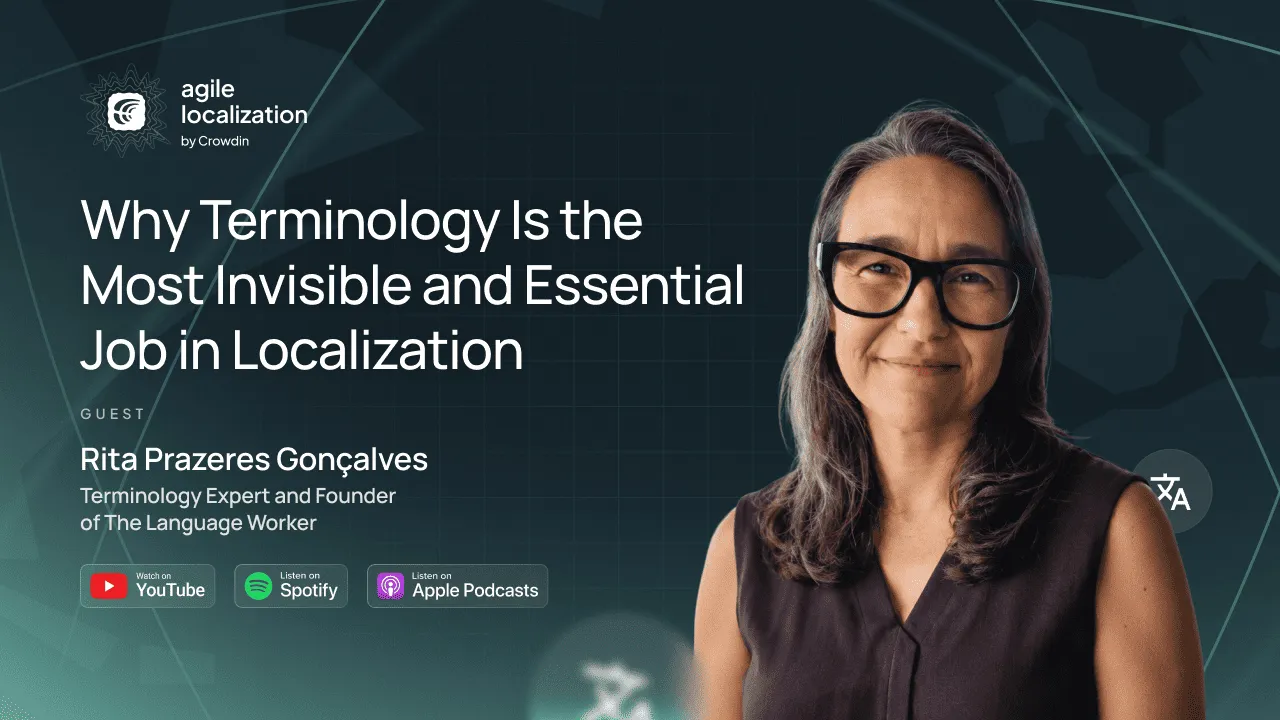
And according to Rita Prazeres Gonçalves, terminology expert and founder of The Language Worker, it might be the most critical yet invisible job in the entire localization industry.
In a recent conversation on The Agile Localization Podcast with host Stefan Huyghe, Rita made a compelling case for why terminology deserves far more attention, and why the current AI boom might finally be giving it the spotlight it’s needed for decades.
Listen to the new episode on:


It’s not undervalued. It’s invisible.
Is terminology undervalued compared to translation or content creation? “I wouldn’t use the term undervalued so much. It’s pretty invisible.”
The distinction matters. People don’t dismiss terminology. They simply don’t know it exists as a standalone profession.
Part of the problem is geographic. In places like Quebec and Catalonia, strict language policies have made terminologist a recognized, hireable role. But in most of the world, terminology duties get tacked onto someone else’s job description without the training or methodology that the work actually demands.
As Rita put it, most people who end up doing terminology work did not intend to do it. It’s the accidental profession of the language industry.
What actually makes a strong terminologist
Rita discovered the field at 15, inspired by a Latin teacher pursuing a master’s in terminology. She went on to study linguistics deeply before working as a lexicographer, a researcher, and eventually a terminology specialist for companies like Apple, Google, and Microsoft.
That academic backbone is what separates intentional terminology work from ad hoc glossary management. A strong terminologist doesn’t just collect words. They dissect terms down to their structure, understand how meaning shifts across domains, and build systems that hold up over time.
Rita calls this process terminology unplugged: going back to basics, picking up a dictionary or a specialized article, and developing what she describes as a terminology intuition through hands-on analysis.
And here’s the thing: AI hasn’t changed the core skill set. The tools have been around for years. What’s been missing is the theory and methodology behind how to use it.
What’s wrong with the AI-generated glossary
This brings up one of the biggest mistakes Rita sees small teams making right now: asking AI to generate a terminology list and treating it as a source of truth. It sounds efficient. It’s actually a trap.
The problem is domain contamination. The same term can mean completely different things in different fields. Rita’s playful example of the computer “mouse” illustrates how language borrows and bends across contexts. Without deep, human understanding of the specific content and client, AI will inevitably confuse domains, hallucinate entries, or miss critical nuances.
The smarter approach, Rita argues, is the reverse: do the human analysis first, understand your content deeply, and then leverage AI with the specificity it needs to actually help.
Minimum viable terminology setup
Start by choosing one client. Pull a sample of 10000 to 20000 words. Have someone who knows the content do a “human eye” terminology pass to identify 200 or so term candidates.
While Rita notes that smaller teams can technically start with a simple Excel sheet to map out fields, she highlights Crowdin as the perfect ecosystem for scaling this collective effort. Working closely with an enterprise software client that uses Crowdin, Rita has seen firsthand how the platform turns terminology from a static file into a living tool.
In Crowdin, language leads and localization managers can connect with engineers, allowing translators to flag term candidates directly within their actual working environment. It connects raw linguistic analysis and automated project management. Grow the glossary organically, project by project.
The secret tool here is ownership. Someone needs the authority and the habit of maintaining the glossary, validating new entries, and keeping the ecosystem alive. Ideally, even the client participates, reviewing and commenting on the glossary to keep it aligned with their intent.
Terminology renaissance?
The industry is in the middle of what Rita calls a terminology renaissance. That happened because AI has forced the conversation.
LSP owners now consistently name terminology as the piece of their workflow that still needs improvement. And what awareness is creating real opportunities.
Whether it’s a full-time terminologist, a fractional consultant, or a linguist with terminology training stepping into an AI orchestration role, the door is opening.
“You don’t need a terminologist, but you need a terminologist.” The awareness is finally there. Now the industry just needs to act on it.
Rita’s background
Rita Prazeres Gonçalves is a Terminology Expert and Founder of The Language Worker, bringing nearly thirty years of specialized expertise in terminology management, localization workflows, and language quality. With a background in linguistics and academic training as a lexicographer and terminology researcher, she has worked with industry leaders, including Apple, Google, Microsoft, and Cisco, advancing her expertise in enterprise-scale language operations.
The views, thoughts, and opinions expressed in this podcast are the speaker’s own and may not necessarily align with those of Crowdin.
Listen to the new episode on:

Yuliia Makarenko
Yuliia Makarenko is a marketing specialist with over a decade of experience, and she’s all about creating content that readers will love. She’s a pro at using her skills in SEO, research, and data analysis to write useful content. When she’s not diving into content creation, you can find her reading a good thriller, practicing some yoga, or simply enjoying playtime with her little one.